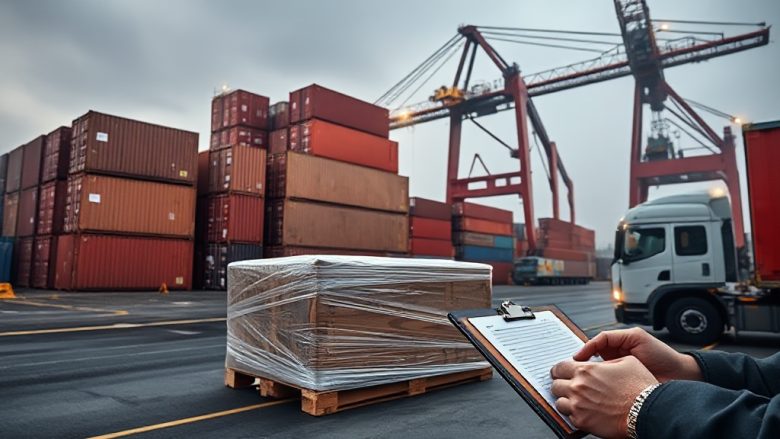
Your supplier in Rotterdam confirms the pallet left their yard on Tuesday. By Thursday it is sitting at a UK port, and your phone starts filling up with messages about a customs entry, a deferment account, a delivery order and something called a tail lift charge. You asked three forwarders for quotes last month and got three different sets of numbers that did not line up. That is the moment most first-time importers realise a freight quote is not one price. It is a stack of services, some of which you can control and some you cannot.
This complete guide to freight forwarding in the UK follows that single pallet all the way to a Midlands warehouse, stage by stage, so you can see what a forwarder actually does, which documents matter, and where costs quietly appear. If you are importing from the EU or Asia for the first time, the sequence below is roughly what you will live through, whether your goods travel by road, sea or air.
What a Freight Forwarder Actually Does Before Your Goods Move
A forwarder is not a haulier and not a customs broker, although many do all three. The core job is coordination. They book space with a carrier, arrange collection from your supplier, prepare and file customs paperwork, and hand the goods to a final-mile courier or your own transport. You are buying their relationships and their systems as much as their trucks.
Before anything moves, you will be asked for a few things that trip people up. Your business needs an EORI number, which is the identifier UK customs uses to recognise you as an importer. If you are VAT registered, you also need to decide how import VAT will be handled, either paid at the border or deferred. Most forwarders will ask whether you want a duty deferment account, because without one you pay duties and VAT on each shipment as it lands rather than monthly.
You will also be asked for a commercial invoice and a packing list from your supplier. These are not optional extras. The invoice drives the customs value, and the packing list tells the forwarder how many packages, what weights and what dimensions they are dealing with. Get these wrong and the quote you were given becomes a guess.
Booking the Shipment and Understanding What You Are Quoted
When you accept a quote, you are usually agreeing to a rate that covers the main leg plus a set of standard charges. What catches first-time importers is that the quote often excludes UK port charges, customs clearance fees and delivery. Those appear later on a separate invoice from the forwarder or their agent, and they can add a meaningful percentage to the headline number.
Ask for a full landed cost estimate before you commit. A good forwarder will break it down without being pushed. The table below shows the lines you should expect to see on a typical road or sea shipment into the UK, and which ones are fixed versus variable.
| Cost line | What it covers | Fixed or variable |
|---|---|---|
| Freight rate | Main carriage from origin to UK port or terminal | Fixed at booking, but subject to surcharges |
| Origin charges | Collection, export documentation, terminal handling abroad | Usually fixed per shipment |
| UK port charges | Terminal handling, security, container lift on and off | Fixed per container or pallet |
| Customs clearance fee | Preparing and filing the import declaration | Fixed per entry, extra if amendments are needed |
| Duty and import VAT | Taxes owed to HMRC based on goods value and commodity code | Variable, depends on your goods |
| Delivery to door | Final-mile transport, tail lift, timed slot, pallet truck | Variable, depends on access and postcode |
| Demurrage or storage | Charged when goods sit at port longer than free time allows | Variable, entirely avoidable |
Two of those lines deserve extra attention. The commodity code on your customs entry determines the duty rate, and if it is wrong you can overpay for months without noticing. The delivery line is where a cheap quote often hides a problem, because a standard 7.5-tonne vehicle cannot always reach a unit on a narrow industrial estate. Tell your forwarder about access restrictions, forklifts and opening hours early.
Documents That Travel With Your Goods
Every shipment carries a paper trail, and missing documents are the single most common reason goods get held. The commercial invoice, packing list and bill of lading or CMR note are the basics. If your goods are food, cosmetics, chemicals or electrical, you may also need certificates of origin, health certificates or conformity markings.
For EU imports, the paperwork burden is lighter than it once was, but it has not disappeared. Rules of origin still matter if you want to claim a preferential duty rate. Your supplier needs to provide a statement on origin, and it has to be worded correctly. A vague line on an invoice is not enough.
Keep digital copies of everything in one folder. When a customs query arrives, you will have hours, not days, to respond before storage charges start. Forwarders who ask detailed questions upfront are usually the ones who keep your goods moving.
At the UK Border: Customs Clearance and Common Delays
This is where the theory meets reality. Your forwarder or their customs agent submits an import declaration to HMRC’s system, usually before the goods arrive. If everything matches, the shipment is cleared and released. If not, it is routed to a channel for inspection, and that is when the clock starts ticking on port storage.
Delays tend to come from a handful of causes. The commodity code does not match the goods description. The value on the invoice looks unusually low compared with similar shipments. The EORI number is invalid or belongs to a different entity. The supplier sent the wrong invoice version. None of these are dramatic, but each one can add a day or more.
There is also the question of who is clearing the goods. If your forwarder clears in their own name and re-invoices you, that is fine for many small importers. But it means the customs record is not in your name, which can matter if you later want to claim preference or prove origin. Ask which model they use before you book.
From Port to Your Door: Final Mile and Delivery Charges
Once cleared, the goods leave the port and head to your address. This leg is where quotes vary most wildly, because delivery pricing depends on weight, pallet count, postcode band and access. A pallet delivered to a warehouse with a loading bay costs less than the same pallet delivered to a shop on a high street with no parking.
Watch for accessorial charges. Tail lift, waiting time, re-delivery after a failed attempt, and out-of-hours delivery all carry fees. If you are not sure whether your site can take an articulated lorry, say so. A forwarder would rather send a smaller vehicle than deal with a failed delivery.
You should also confirm who is responsible for unloading. Many economy services are kerbside only, which means the driver will not bring the pallet inside. If you do not have a forklift, book a service with a tail lift and arrange someone to move the goods.
Red Flags When Choosing a Freight Forwarder
Most forwarders are competent, but the market has plenty of resellers who simply pass your shipment to someone else and add a margin. Here is what should make you pause.
A quote that is dramatically cheaper than everyone else, with no breakdown, usually means something is excluded. A forwarder who cannot explain what a deferment account is, or who cannot tell you which port your goods will arrive at, is likely a broker rather than an operator. Slow or vague answers about customs clearance are a warning sign, because that is the stage where problems become expensive.
Be wary of anyone who asks you to under-declare the value of your goods. That is not a clever shortcut. It is fraud, and it lands on you as the importer. Equally, avoid a forwarder who will not put their terms in writing or who changes the price after booking without explanation. Surcharges do happen, especially on sea freight, but they should be documented.
Finally, check whether they handle the commodity you are importing. A forwarder who moves furniture all day may not be the right choice for lithium batteries or temperature-sensitive goods. Specialisation matters more than a flashy tracking portal.
Frequently Asked Questions About UK Freight Forwarding
Do I need my own EORI number to import into the UK?
Yes, if you are the importer of record. You can sometimes use a forwarder’s EORI, but that means the customs record is not in your name. For a first shipment it may be simpler, but as you scale, having your own EORI gives you control over duty relief, preference claims and records.
How long does customs clearance take at a UK port?
If the declaration is correct and the goods are not selected for inspection, clearance can happen within hours. If HMRC or the port operator flags the shipment, it can take a day or more. The biggest variable is whether your documents match the declaration exactly.
Can I avoid demurrage and storage charges?
Mostly, yes. Submit complete documents early, respond to customs queries quickly, and make sure your delivery is booked before the free time at the port runs out. Demurrage is rarely a surprise; it builds up while goods sit waiting for paperwork or payment.
Is it cheaper to use one forwarder for everything?
Not always. A single forwarder handling collection, customs and delivery is simpler to manage, but a specialist customs broker plus a separate haulier can sometimes be cheaper for regular shipments. For a first import, simplicity is usually worth more than the saving.